
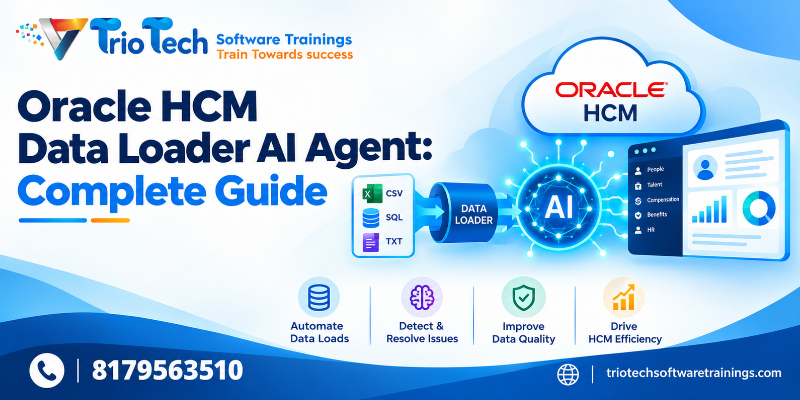
Oracle Fusion Cloud HCM is always improving through artificial intelligence, automation, and intelligent agents that allow companies to streamline their complicated HR processes. One of the processes that could be improved by means of the technologies mentioned above is Oracle HCM Data Loader (HDL). HDL is extensively used for loading and maintaining HCM data, whereas AI features will enable professionals to be more efficient with data and detect problems within operational processes.
For professionals interested in gaining experience in Oracle Fusion HCM AI, it would be useful to know about the connection between HDL, automation, AI, and intelligent agents. This guide will provide information on Oracle HCM Data Loader, functions of AI agents, use cases, advantages, and required skills for professionals.
What Is Oracle HCM Data Loader?
Oracle HCM Data Loader, also referred to as HDL, is a feature of Oracle Fusion Cloud HCM that helps organizations load and manage HCM business objects. Some of the information that organizations may wish to load into the system include employee records, assignments, jobs, departments, positions, locations, compensation, and more workforce-related data.
Rather than key in thousands of records in the HCM user interface, organizations can prepare structured data and then upload them into Oracle HCM using HDL.
The following is the general procedure of HDL:
- Data preparation.
- Creation of HDL file.
- Upload of the file into Oracle HCM.
- Processing of the data.
- Validation.
- Correction of errors (if any).
- Processing of the correct records.
- Ensuring successful data loading.
Therefore, HDL is an essential tool for Oracle HCM technical consultants, integration developers, implementation specialists, and support team members.
What Is an AI Agent in Oracle Fusion HCM?
The AI agent is supposed to support users performing their business processes through the implementation of AI capabilities, context, and automation. There are certain tasks which can be completed using AI capabilities within Oracle Fusion HCM which would help employees, managers, HR staff and administrators complete their tasks.
The AI agent does not have to be considered as HDL alone. The AI agent might assist professionals who are involved in various processes around the data management life cycle to understand the information, detect problems, produce recommendations and automate tasks.
For instance, consider that an HR team is planning an employee data migration. The technical consultant can use AI-assisted capabilities to analyze data requirements, detect inconsistencies or errors without doing a full review manually.
This is when knowledge about Oracle Fusion HCM AI becomes even more crucial.
How AI Can Help with the HDL Process
A traditional HDL process can require some technical expertise, proper data preparation and thorough analysis of the errors. An AI can complement the above-listed efforts and help with certain aspects of the process.
1. Identifying Requirements
HDL requires the right business-object structure and attributes. The consultant needs to understand what is required and how different attributes are related to each other.
With AI-assisted tools, professionals would be able to analyze requirements and understand the meaning of different data elements.
It will ease understanding of HCM structures for the beginners.
2. Discovering Data Quality Issues
Data quality is the main challenge in HCM implementations and migrations.
Some common issues can be:
- Missing data
- Wrong formats
- Invalid identifiers
- Duplicated records
- Wrong date
- Organizational data inconsistencies
- References between business objects are invalid
An intelligent tool would help identify potential issues before or during the data loading process.
For instance, if there is always the same unusual value in employee records in a certain field, then an AI tool would help notice that issue.
3. Analyzing HDL Errors
For beginners, an HDL error can be difficult to analyze since a wrong attribute or relation can lead
How AI Can Help with the HDL Process
A traditional HDL process can require some technical expertise, proper data preparation and thorough analysis of the errors. An AI can complement the above-listed efforts and help with certain aspects of the process.
1. Identifying Requirements
HDL requires the right business-object structure and attributes. The consultant needs to understand what is required and how different attributes are related to each other.
With AI-assisted tools, professionals would be able to analyze requirements and understand the meaning of different data elements.
It will ease understanding of HCM structures for the beginners.
2. Discovering Data Quality Issues
Data quality is the main challenge in HCM implementations and migrations.
Some common issues can be:
- Missing data
- Wrong formats
- Invalid identifiers
- Duplicated records
- Wrong date
- Organizational data inconsistencies
- References between business objects are invalid
An intelligent tool would help identify potential issues before or during the data loading process.
For instance, if there is always the same unusual value in employee records in a certain field, then an AI tool would help notice that issue.
3. Analyzing HDL Errors
For beginners, an HDL error can be difficult to analyze since a wrong attribute or relation can lead
Real-life HDL AI Agent Example
Suppose we are talking about a migration of 20,000 employees into Oracle Fusion HCM.
A typical process would be as follows:
Source System → Data Transformation → HDL File → Upload → Validation → Error Analysis → Correction → Reprocessing
However, we can assume the implementation of AI support services around such a process.
The system will be able to help the consultant recognize the most frequent data quality issues, describe the failure of individual records, interpret validation errors, and categorize issues by cause.
For instance:
Issue: Assignments of employees fail validation.
AI assisted analysis: Multiple records seem to have a value that refers to a non-existing organization in the target environment.
Recommended investigation: Ensure correct mapping of organizations and verify that the required organization exists.
The responsibility of the consultant would be to validate the diagnosis and implement the proper fix.
Advantages of Studying Oracle Fusion HCM AI
It is possible to highlight some benefits that technology professionals will gain by studying AI and Oracle HCM simultaneously.
Enhanced Problem Solving Skills
AI will help professionals analyze large sets of data quickly and find patterns.
Greater Productivity
The automation of analysis processes will enable professionals to dedicate more time to configuration and other tasks.
Enhanced Data Quality
The AI-based analysis process will enable professionals to find data inconsistencies.
Quicker Learning
The use of AI for explanation purposes will help beginners learn Oracle HCM faster.
Future-Ready Skills
All of the above-mentioned skills related to Oracle HCM, AI, automation, APIs, integrations, and data management are becoming increasingly relevant to the modern world of enterprise technology.
Skill Requirements for Oracle HCM AI Careers
Professionals looking to join this field need to have competencies in both functional and technical domains.
The key competencies include:
- Oracle Fusion Cloud HCM basics
- Oracle HCM Data Loader
- HCM Extracts
- REST APIs
- SOAP services
- Oracle Integration Cloud
- Data migration
- HCM business objects
- HDL troubleshooting
- Security concepts
- Redwood user experience
- AI basics
- Automation basics
- Integration architecture
It is also crucial for professionals to know about the HR business processes. Technical knowledge gains more importance when professionals understand the business processes of employees, workforce, recruitment, compensation, and organizations.
The Need for Oracle Fusion HCM AI Training
With organizations moving towards intelligent enterprise applications, it is essential for individuals to be aware of the connection between HCM technology and artificial intelligence.
An Oracle Fusion HCM AI Training course will help individuals learn about HCM concepts as well as the aspects of AI and automation along with current Oracle technologies.
For newbies, training will offer a learning pathway, whereas, for seasoned Oracle professionals, training with emphasis on AI will assist them in expanding their HCM knowledge.
An effective training method should involve practical exercises as well, not just theories. Individuals should get hands-on experience on creating HDL files, debugging issues, learning about APIs, integration, and more related HCM concepts.
Conclusion
Oracle HCM Data Loader continues to be a relevant technology for handling and migrating the workforce data in Oracle Fusion Cloud HCM. Given that Oracle cloud applications are increasingly integrating AI and intelligent automation, professionals need to know how AI could help in managing their HCM data.
The AI assistant could aid in performing tasks like analyzing the data, understanding errors, guiding the process, and performing other repetitive tasks, while HDL continues to play an important role in loading and maintaining HCM data.
Those who wish to work as Oracle consultants or developers could build a good foundation using Oracle HCM Data Loader, Oracle Fusion HCM AI, APIs, integration, automation, and Redwood.
Learning Oracle Fusion HCM AI through training can prepare professionals for future demands in HCM projects.